Cost
What an ADU actually costs
Most cost pages give you a price per square foot and a confident total. The per square foot number is the easy part and it is not what breaks budgets. This page is the complete list of line items instead, including the ones people find out about in month three.
- Free
- No account
- No phone number
- Your result first
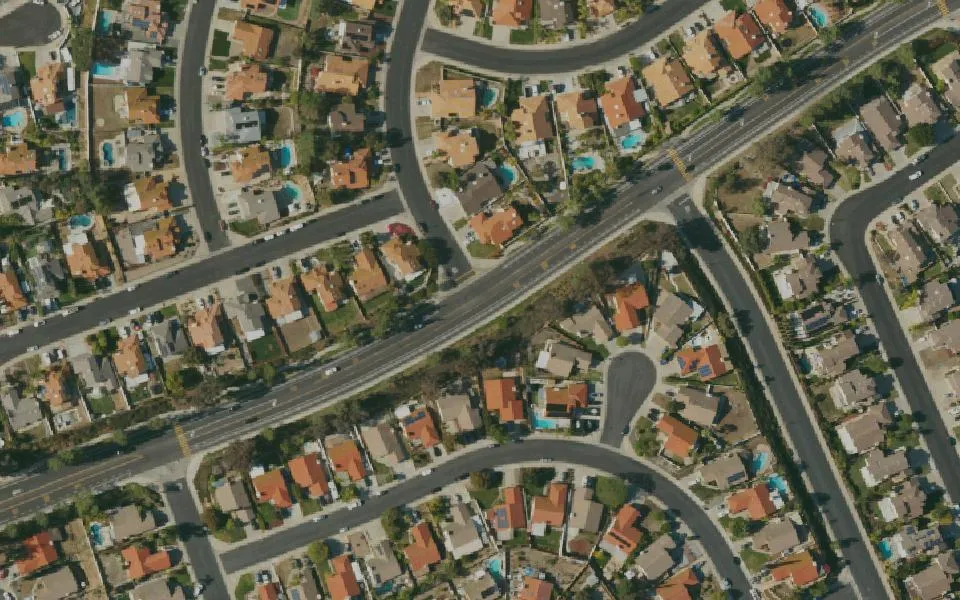
Aerial: USGS/USDA NAIP
Where the money goes
The four things you are paying for
Only one of these is the per-square-foot number everyone quotes, and it is not the one that breaks budgets.
Design and plan preparation
The largest cost you can actually control.
- An architect's drawings
- Structural engineering
- Two or three correction rounds with the city
- A pre-approved plan removes most of it — the drawings exist and have already been reviewed
Permits and fees
Set by your city and your water district, not your builder.
- Building permit and plan check, per your city's schedule
- Impact fees — waived under 750 sq ft by statute, in every city
- School facilities fees, per sq ft, with a small-unit exemption
- Water and sewer connection — charged by your water district, and Eastern, Rancho California, Elsinore Valley and Western do not charge the same
Construction
The part everyone quotes per square foot.
- The most predictable number in the project
- Scales with size and with finish level
- A garage conversion is substantially cheaper — the foundation, walls and roof already exist
Site work, where budgets die
Invisible until someone walks the property.
- Electrical panel capacity — a service upgrade before you pour
- Sewer distance, or a septic capacity review — can end a project
- Slope, grading and soil, which may force a different foundation
- Fire zone rules and rear-yard easements, either of which can kill a perfect spot
Our lot check does not cover any of item 4, and we say so up front. The geometry question is answerable from public records in seconds. These are not.
The one rule that travels
Size decides more of the fee bill than anything else
- 750sq ftBelow this, development impact fees are waived by statute — not by your city's goodwill
- 500sq ftThe usual school-fee exemption line, a second and lower cliff
- 30daysReview for a pre-approved plan under AB 1332, which removes most of item 1
These are cliffs, not slopes. A unit at 749 sq ft and one at 751 sq ft cost about the same to build and can differ by five figures in fees. If you are choosing between two plans a few feet apart in size, that is usually the whole decision.
The amounts differ by city. The threshold does not.
Your city
What each counter will actually tell you
Fee schedules are published unevenly across the six cities. Rather than average one real schedule across five others — which would look more useful and be less true — here is exactly where each one stands, and what to ask for.
| City | Impact fees | What is published |
|---|---|---|
| Murrieta | Waived under 750 sq ft, proportional above | No ADU line item anywhere in the FY2026-27 user fee schedule — all 75 pages of it. Permits are priced as valuation-based residential work, so the figure follows your construction value. |
| Temecula | Waived under 750 sq ft | Review timelines only — 7 to 10 business days for an unmodified pre-approved plan, 60 days otherwise. No dollar amounts; the handout points at a general fee page. |
| Menifee | $0 under 750 sq ft, proportional at 750 and above | The rule is written into the code. The dollar amounts are not. |
| Lake Elsinore | Not published | No ADU-specific fee schedule located. |
| Perris | Set by council resolution | Amounts are set by resolution rather than written into the code, so there is no figure to cite. No ADU-specific fee schedule or timeline either. |
| Wildomar | $0 under 750 sq ft, up to $31,479 at 750 and above | A complete ADU fee schedule, with dollar amounts. |
A worked example
Wildomar: real numbers, for shape rather than amount
Wildomar is the only one of the six publishing a complete ADU fee schedule, so it is the only place we can print dollars without inventing them. These are Wildomar's own figures and they apply to Wildomar. Read them for the pattern — where the cliffs fall, which line items exist at all — rather than as a regional average.
| Line item | Wildomar |
|---|---|
| City development impact fees | $0 under 750 sq ft, up to $31,479 at 750 sq ft and above |
| School facilities fees | $0 up to 500 sq ft, $6,204 at 501 sq ft and above |
| Planning fee | $0 |
| Building permit and plan check | Up to $5,759.57 |
| Pre-approved plan set | $0 from the city |
| EVMWD water and sewer connection | $170 |
| County Environmental Health, if well or septic | $796 |
| Southern California Edison service | $3,000–$30,000; roughly $3,000–$5,000 to expand existing service, with up to a $5,700 credit for all-electric |
Wildomar ADU Guidebook, November 2025
For comparison, the city puts a custom plan set at roughly $15,000, and an architect at $3,000–$10,000. Its own plans are free, which is the single largest controllable cost in the project.
Three ways to cut the cost meaningfully
- Use your city's pre-approved plan. Removes most of the design cost and compresses approval to 30 days, ministerially. See what your city publishes.
- Stay under 750 square feet if the extra space is not essential. The impact fee waiver is statutory, not discretionary.
- Convert instead of building new where it suits you. An existing garage already has a foundation, walls and a roof. On a tight lot it may also be the only thing that fits — which is a result our tool will show you directly.
Does it pay for itself?
We are not going to quote you a rent figure or a resale premium, because the ones circulating on competitor sites are unsourced and we have not independently verified them. Repeating someone else's marketing number as our own research would be exactly the behaviour this site exists to avoid.
What we can tell you without inventing anything:
- You are not required to live on the property. AB 976 made the prohibition on owner-occupancy requirements permanent, so renting the unit out is available to you.
- Your HOA cannot prohibit the unit. It can apply reasonable architectural standards, which costs time rather than permission.
- An ADU triggers reassessment of the new construction only. Your existing Proposition 13 base year value on the main house is not disturbed.
For an actual rent figure, look at current listings on your own street. That is better evidence than any citywide average, including ours.
Start with whether it fits
Cost only matters if the unit can physically go on your lot. That question is free to answer and takes about ten seconds.
Find out if it fits before you budget
None of these costs matter if the unit cannot go on your lot. That check is free.